





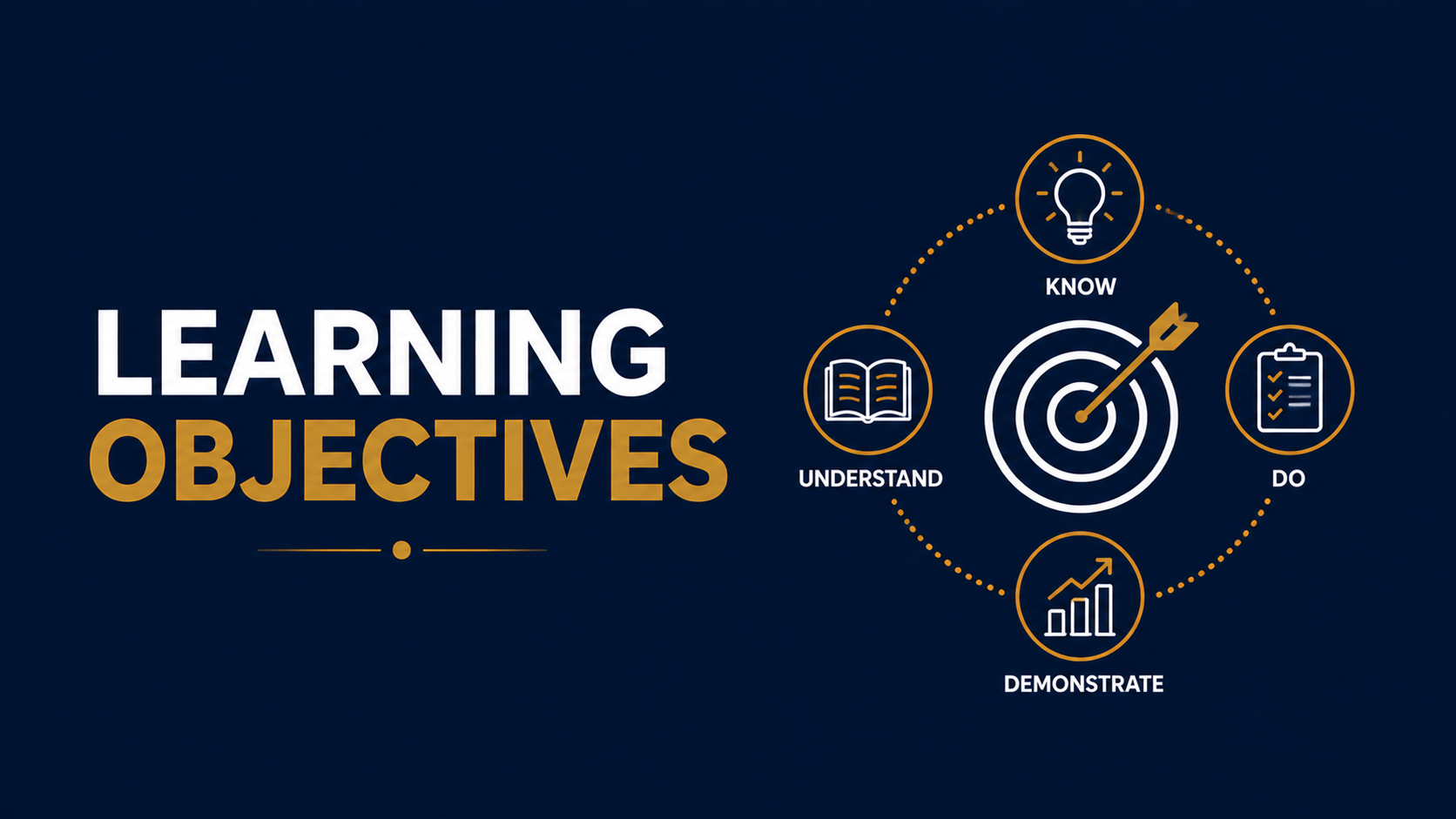
Why Learning Objectives Matter Learning objectives are the foundation of effective training. They define exactly what participants are expected to know, do, or demonstrate by the end of a lesson. For instructors, they provide a clear direction when planning, delivering, and assessing training. For participants, they set clear expectations and help focus attention on the most important outcomes. Without clear learning objectives, lessons can become activity-driven rather than outcome-driven. An engaging activity is valuable only when it contributes to achieving a specific learning objective. What Are Learning Objectives? A learning objective is a concise, measurable statement describing the expected learning outcome. It explains what a participant should be capable of demonstrating at the end of the lesson. Learning objectives are different from learning aims. Learning Aim: Describes the overall purpose or intention of the lesson. Learning Objective: Describes the specific outcome that participants are expected to achieve. Think of the learning aim as the destination and the learning objectives as the route that guides participants towards it. Example Learning Aim Provide participants with the knowledge and practical understanding to safely perform a pre-use inspection of personal fall protection equipment. Learning Objectives Explain the purpose of a pre-use inspection. Perform a pre-use inspection of a full-body harness. Demonstrate responsibility for identifying and reporting defective equipment. Each objective contributes directly to achieving the overall aim. Learning Objectives and the GWO Taxonomy Within the GWO Taxonomy Framework, every learning objective belongs to one of three learning domains:
Teachbacks are one of the most important parts of the IQT learning process. They give instructor candidates the opportunity to move beyond theory and demonstrate how they plan, prepare, deliver, facilitate, assess, and reflect on learning activities. In the IQT course, teachbacks are not treated as simple presentations. They are structured learning sessions where participants practise the instructor skills developed throughout the course. Each teachback increases in complexity, allowing participants to build confidence, receive feedback, and demonstrate progressive competence against the IQT learning objectives. The attachment confirms that the primary assessment of IQT participants is based on the delivery of teachback sessions, supported by structured assessment forms and individual feedback records. What Is an IQT Teachback? An IQT teachback is a practical teaching session delivered by a participant during the IQT course. The participant takes the role of instructor and delivers a planned learning activity to the group. The purpose is to demonstrate the participant’s ability to: Present information clearly. Organise learners. Use teaching aids and learning activities. Apply adult learning principles. Encourage learner participation. Manage the learning environment. Provide feedback. Assess whether learning objectives have been achieved. Before the course, participants must prepare two teachback sessions. The first is a 10-minute opening presentation based on a topic from the GWO standard introduction lesson. The second is a 25-minute lesson on a topic of the participant’s own choice, preferably something they know well and are passionate about. Participants are encouraged to bring props, materials, or visual aids to support learning during the second teachback. Why Teachbacks Matter Teachbacks help participants practise the skills addressed during the course while continuing to explore the training content. They allow participants to apply their knowledge through the full learning cycle: planning, preparing, delivering, assessing, and reflecting. The teachback process supports instructor development because it gives participants a safe and structured opportunity to test their teaching approach, receive feedback, and improve. For many instructor candidates, the teachback is where the course becomes practical. It shows whether the participant can move from knowing the content to helping others learn it. The Five IQT Teachback Sessions The IQT course includes five teachback sessions. Each one has a different purpose and duration, and each one builds on the learning from the previous days.
Cooperative Learning is often referred to in the abbreviation CL . The structures in the CL discourse are the specific, pre-defined patterns of cooperation, exercises, and activities that are carried out. A consistent principle in CL is that it is the students’ active learning work that constitutes the learning processes, and every single student, without exception, must be involved in these processes. The structures ensure that all students are actively engaged in learning processes simultaneously and can therefore do what the teacher cannot - namely, be in 24 places at once. Everywhere, the structures trigger engagement and eagerness among students and amazement among teachers at the enormous energy with which their students throw themselves into the learning processes. The learning perspective in CL is social constructiveness and is based, among other things, on the ideas of the Soviet psychologist Lev Vygotsky, who saw learning as a social process taking place in interaction with others. A bonus element in CL is precisely the development of social competences . Students should not learn one at a time when the teacher has time but simultaneously. And every single student in the class must be engaged. The goal is that all students, as a fundamental condition of teaching, are in dialogue, receive feedback, and thereby formulate their way to understanding the subject matter and their world. Learning is more likely to take place when students are motivated and emotionally involved in what they are doing. CL is a very special - almost paradoxical - combination of, on the one hand, student-centered teaching with a very high level of student activity and rich opportunities for individual expression, and on the other hand, a relatively high level of teacher structuring , which ensures that the work processes can proceed with maximum benefit for everyone. CL structures do not require special teaching materials. Since CL is another way of interacting about the subject matter, not another kind of subject matter, all forms of teaching materials can be used . The Pedagogical Principles Often, in a class, there will be students who hold back when questions are asked - either due to insecurity, because some need longer reflection time than others, or because a few always come first, eager to contribute. When teaching takes place in CL structures, all students are active. A structure only becomes a teaching activity when the teacher puts content into it. Because the structures are so flexible, they can be combined not only with any form of academic content but also with different types of courses and, to some extent, other pedagogical ideas. The Four Principles (SPIE) 1. Simultaneous Interaction All participate actively in communicative learning processes at the same time. 2. Positive Interdependence There is positive interdependence when students benefit from others doing well, and when each student needs others’ participation to complete the learning work. Others’ success contributes to one’s own and makes the process fun and stimulating. 3. Individual Accountability In CL, students are repeatedly asked during a lesson or course to summarize, present, question, or evaluate their understanding and thinking about the subject matter. 4. Equal Participation Participation is equal when all contribute equally and are equally involved in the work. CL structures ensure high levels of participation by requiring students to take turns contributing. Teams and Team Formation A team is not the same as a group - it is socially integrated according to principles that promote tolerance, cooperation skills, democracy, and constructive dialogue among students. An important element in CL is working in heterogeneous teams - teams where members are as different as possible. Therefore, careful planning of team composition is recommended. Research and experience show that heterogeneous teams provide the best results for both strong and weaker students. Stronger students help weaker ones but are also challenged by the many perspectives and explanations that emerge in a diverse team. The Teacher & Structuring The teacher’s role in CL is special: she initiates and guides students through structures but steps back as a “consultant” once the work begins. Clear time frames are necessary, as they motivate and focus the work. At the end of a structure, the teacher may summarize answers, facilitate knowledge- sharing, or let students apply their new knowledge in other structures. Because students verbalize their learning, the teacher can follow their processes and identify those needing help - this is what Kagan calls “authentic assessment.” Other elements: · Noise level control (long vs. short voices). · Quiet signal (raising hand until all follow). · Three-before-me rule (students ask team first – and then the teacher). Social Skills Building good social relations and developing social skills is built into CL. Values like tolerance, respect, and cooperation manifest in daily interactions. · Team building : activities to strengthen bonds and create trust. · Class building : mixing and rotating students to build relations beyond teams. · Icebreakers : standing/joining activities to highlight commonalities. The teacher’s own behavior also strongly influences students (Rosenthal effect: teacher expectations shape performance). Positive, consistent communication from the teacher creates a supportive learning climate. Knowledge and Skills Acquisition Knowledge mastery : acquiring “high consensus” knowledge (e.g., Pythagoras’ theorem, language). Skills mastery : developing abilities through repeated practice. CL enhances both because: · Engagement time increases. · Immediate feedback keeps processes focused. · Frequent summarization strengthens memory. · All students, even quiet ones, are active. · Safety in structures gives courage to try. · Variation appeals to different learning styles. Thinking Skills Students’ thinking must be central. CL values both creative and critical thinking. Because students must articulate ideas to others, they structure and clarify their thinking. Working with different perspectives inspires and challenges them. Team safety allows creativity and experimentation. Communication in the Classroom CL, based on social constructivism, places language and communication at the center of learning. Students learn much more of what they say than what they only hear. Constant verbalization develops vocabulary and concepts. Negotiating meaning with peers is crucial, ensuring that all are engaged at once. Positive feedback is precise, constructive, and benefits both giver and receiver. Knowledge Sharing, Presentations, and Differentiation Traditional presentations often disengage listeners. In CL, the learning happens during preparation and presentation , not in audience size. Differentiation is essential - structures allow support across levels, activating students in many ways (physical, visual, kin-esthetics, communicative, cognitive). Stronger students benefit because they must restructure and explain knowledge, while weaker students expand understanding by asking different questions. Gardner’s multiple intelligence are used to design “broadband” teaching that stimulates learners in varied ways. Structures and Time Management Tasks are solved in structures - organized communication and process. · Choose structures you’re comfortable with but also try new ones. · Demonstrate structure at first. · Establish order of speaking. · Use color codes for simplicity. · Summarize and conclude for learning to be secured. Time limits create urgency and focus - short enough to feel challenging. Body and Movement Movement enhances concentration, memory, and oxygen supply to the brain. Standing or moving stimulates learning and prevents restlessness. It also makes learning experiences more enjoyable. Preparation and Use in Lessons CL does not necessarily require more preparation it may even reduce workload. Few tasks in structures can generate long, concentrated processes. Start with simple structures and build a CL “toolbox.” During lessons, all students should work in the same structure simultaneously, though with different texts or tasks. CL in Lectures Lectures are not optimal for learning attention fades, and much is forgotten. Using short CL structures after 8–10 minutes enhances retention and engagement. Benefits: · Misunderstandings are caught early. · Creates variety. · Reflection consolidates learning. Changing teaching practices is demanding, but collaboration with colleagues increases success. Working with CL together is more enriching and sustainable. What Do Others Say About CL? From Annette Hildebrandt Jensen’s foreword (Perspectives on Cooperative Learning, 2012): · CL = Learning as participation. · A special way to organize teaching and learning. · Creates more physical/mental activity and dialogue. · Meaning arises in interaction, especially between differing voices. · Not a miracle cure, but a valuable tool. From Professor Lars Qvortrup: · Not “either-or” but “both-and.” · Teaching must connect to students’ interests and conditions. · Teacher’s role: not only to teach but to organize structures for learning communication . · Learning communities strengthen both cognitively and socially. · Clear beginnings, themes, and goals are essential. · Vary teaching forms to avoid monotony and signal new learning phases. · Collective and individual contributions are interdependent. · Good classroom leadership increases learning outcomes, regardless of method. · Teaching is always partly unpredictable teachers need a wide repertoire of methods. · Teaching balances intent and individual freedom. · Technology and freedom, structure and complexity must be combined.
Digital tools have become an essential part of how we teach, learn, and connect. For instructors and training providers, they offer new ways to deliver knowledge, encourage collaboration, and assess progress, but only when used thoughtfully and with purpose. This article explores how trainers can select and use digital learning tools effectively in their learning environments. Understanding the Categories of Digital Tools Digital learning tools serve different purposes across the learning journey. They can be grouped into six key categories — each supporting a specific stage of learning and teaching: Content Delivery (Input & Knowledge Building) Tools that provide or present learning materials — such as videos, presentations, and e-learning platforms. Examples: Moodle, Canva, EdApp, LinkedIn Learning, Synthesia, PowerPoint, Articulate 360. Reflect: How engaging is the content? Can it be personalized for each learner? Exploration & Research Platforms that support independent inquiry and information gathering, including AI-assisted search. Examples: ChatGPT, Microsoft CoPilot, Perplexity AI, Wikipedia, DeepL. Reflect: Is the information reliable and up to date? Do learners know how to evaluate their sources? Collaboration & Discussion (Social Learning) Spaces for communication, teamwork, and shared reflection. Examples: MS Teams, Miro, Padlet, Trello, Zoom, Google Meet. Reflect: Do these tools make collaboration easy and inclusive? Practice & Application (Deepening Knowledge) Interactive tools that help learners apply what they’ve learned through practice and repetition. Examples: Kahoot, Quizlet, Mentimeter, Microsoft Forms. Reflect: Are the exercises motivating and adaptive to learner needs? Reflection & Feedback (Formative Evaluation) Tools that enable learners to self-assess, reflect, and receive constructive feedback. Examples: Mentimeter, Padlet, SurveyMonkey, Microsoft Loop, Poll Everywhere. Reflect: How do these tools encourage honest self-reflection and growth? Assessment & Certification (Performance Evidence) Systems for measuring achievement and issuing certificates. Examples: Canvas Quizzes, EdApp Assessments, Google Forms, Microsoft Forms. Reflect: Are the assessments fair, transparent, and secure? Pedagogical Orientation: The Pedagogy Wheel The Pedagogy Wheel is a helpful model for choosing digital tools with purpose. It connects learning objectives, methods, and technologies — guiding instructors to use each tool at the right stage of learning. Version 6 focuses on traditional and non-AI tools. Version 7 integrates AI-supported learning , reflecting the evolving digital landscape. By mapping digital tools to Bloom’s Taxonomy and the SAMR model, trainers can design learning experiences that build from simple understanding to deep application and creation. A Note of Responsibility Before adopting any digital platform, trainers must consider: Data protection and privacy regulations (GDPR, POPIA, etc.) IT and security policies of their organization Accessibility and compatibility with existing systems Choosing a tool responsibly ensures a safe, inclusive, and professional learning environment. Guiding Reflection for Trainers When choosing and using digital tools, ask yourself: Does this tool enhance learning or just add complexity? Can it adapt to different learning styles and abilities? How does it support collaboration and feedback? Is it aligned with my learning objectives and assessment methods? These questions help trainers make deliberate, evidence-based decisions that improve both teaching quality and learner experience. Digital tools are not a replacement for good teaching, they are an extension of it . When chosen with intention, they make learning more interactive, reflective, and accessible. “Technology doesn’t teach — people do. But with the right tools, people can teach even better.”

Active listening is one of the most valuable skills anyone can develop. It’s the difference between hearing words and truly understanding what someone is saying. Whether in a classroom, on a wind farm, or during a team meeting, active listening helps create trust, connection, and clarity. What Is Active Listening? Active listening means being fully present in a conversation, giving your attention to the other person without distraction, judgment, or assumption. It’s not just about waiting for your turn to speak, but about showing the other person that their message matters. When we actively listen, we build stronger relationships and avoid misunderstandings that can lead to errors or conflict. Techniques That Make Listening Active Here are some simple techniques you can start using right away: Paraphrasing – Repeat what the other person said in your own words to confirm you understood correctly. Example: “So, you’re saying the equipment wasn’t working after the inspection?” Verbalizing emotions – Acknowledge what the other person might be feeling. Example: “That must have been frustrating for you.” Asking for clarification – Check that you’ve interpreted things correctly. Example: “When you mentioned the chain hoist, was that before or after the maintenance check?” Summarizing – Briefly restate the main points to show you were paying attention. Example: “Let’s confirm: you inspected, reported, and then replaced the unit, correct?” Continuing the conversation – Encourage the person to share more by asking simple prompts like “And then?” or “What happened next?” These actions turn a one-way conversation into a two-way understanding. Listen With Your Eyes Too Listening is not only about words. Pay attention to nonverbal cues : Eye contact and nodding show engagement. Open posture and calm gestures help the speaker feel safe. Facial expressions should reflect empathy and genuine interest. The way you look when listening can be as powerful as what you say. The Right Attitude for Listening To listen well, start with respect. Approach every conversation with a positive attitude and genuine curiosity. Put yourself aside for a moment. Focus on the other person’s needs and message. Show interest in them as a human being. Try to understand their motives and feelings before responding. This mindset makes listening more than a skill it becomes an act of care. Giving and Receiving Feedback Active listening is essential when giving or receiving feedback. When giving feedback: Speak directly, but kindly. Focus on behavior, not personality. Be clear, specific, and objective. Use “I” statements to own your perspective. Always start with what went well before discussing improvements. When receiving feedback: Listen without interrupting or defending yourself. Ask questions if something isn’t clear. Reflect on what you’ve heard before reacting. Thank the person for sharing their view. Good feedback conversations strengthen relationships and improve teamwork. Active listening is simple, but it requires practice. Every time you listen with your full attention, you create a safer, more respectful, and more connected environment, whether that’s in training, on-site, or during a normal workday. “When you truly listen, you show others that they matter.”
Learning as an adult is not always straightforward. Adults bring real responsibilities, past experiences, confidence levels, work pressure, and personal expectations into the learning environment. These factors can sometimes create barriers that affect participation, motivation, and progress. Common barriers include limited time, fear of making mistakes, and not having access to the right learning resources. When these barriers are recognized early, they can be managed through flexible learning options, supportive guidance, realistic practice opportunities, and clear encouragement from the instructor. Understanding learning barriers helps instructors create a safer, more practical, and more inclusive learning environment where learners feel supported, capable, and willing to keep improving. Peter Toft, First Aid Instructor - Dressing of Abdominal Injury (Case Study) Learning Objectives Understand the learning potential hidden within learners’ barriers to progress. Identify where learning and development barriers may exist in your team or training group. Distinguish between resistance to learning, defense mechanisms, and learning incorrectly. Learn how, as a manager or trainer, you can help unlock learners’ motivation and engagement. Case Introduction – Welcome Onboard Peter Toft glances at the clock and calls out to the class: “Come on, last ones. Five minutes left. You’ll all need to apply the abdominal dressing.” He looks across the room, where participants are busy practicing on each other. In several small groups, the atmosphere is light. Well-trained soldiers squeal as bare skin meets the cold linoleum floor, and others tease them for being “soft.” Torsos pale from winter are being bandaged, while the conscripts chat about anything and everything—last night’s trip into town, motorbike gear, a long-legged admin clerk, Sergeant Hansen’s flat tire, and the possibility of a deployment to Mali. “I wonder if everyone caught the point about the loose bag,” Peter thinks. “I’d better check them one by one.” Who and What Is This About? The Instructor Peter Toft is a sergeant in the Horse Guard Regiment. He completed a first aid instructor course at FSU several years ago and has since been teaching first aid to conscripts for nearly three years. The instructor course gave him many practical tools to make lessons engaging, and he’s developed a real passion for teaching. During a deployment to Helmand two years ago, Peter saw firsthand how proper first aid made a decisive difference in the recovery of wounded comrades. These experiences reinforced his commitment to teaching first aid seriously and effectively. Peter wants his students to learn how to help correctly and with purpose . He gets frustrated when someone doesn't grasp the material. He favors letting students learn through hands-on practice and usually begins his sessions with a short motivational presentation, followed by group practice exercises. The Participants The conscripts in the 2nd Squadron of the Horse Guard Regiment are having a first aid lesson today, with Sergeant Toft as their instructor. Lessons are mostly delivered in buddy teams or small groups that the conscripts form themselves. Sometimes, this creates anxiety, especially for those left out. But despite the occasional awkward group dynamics, Toft’s lessons are popular. They’re active, and the learners get to explore the material themselves. For this session, the class has split into groups of three or four, and they’re fully engaged in applying abdominal dressings on each other.